Notes & Thoughts
A collection of my thoughts, notes, and personal life reflections.
Notes & Thoughts
July 20, 2026
Hello, dear reader, and I love that you read this!
Today is my birthday, and I am writing. I didn't do anything all day. I didn't go outside with friends, didn't hang out, didn't talk to anyone. I just gave myself a full day to think about myself.
Who am I? What is my life story, and what have I done? Today I am thinking only about me.
Advice to my younger self: Be exactly who you are.
I have grown up. I am a young man now. I am trying to do something, and I fail often.
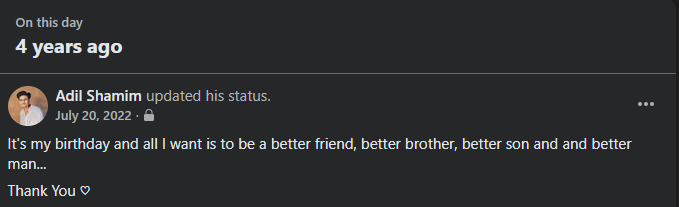
But when I was younger, I had a lot of questions in my mind, and I was confused about my life. On 20 July 2022, I wrote this:
I am writing this because maybe my future self will need these words one day. Maybe it will help you too, reader.
Right now, my number one priority in life—above happiness, above work—is my health.
Try to exercise every day, because if you are willing to make a short-term sacrifice, you will receive long-term benefits.
If you keep making easy choices now, your life will become much harder later.
Everyone says they do it, but very few people actually do it.
“If thoughts come, thoughts come. I’m not going to fight them. I’m not going to embrace them. I’m not going to think harder about them. I’m not going to reject them. I’m just going to sit here for an hour with my eyes closed.”
The first thing to realize is that you can observe your mental state.
When I overthink, sometimes I tell myself: Who cares? I’m going to die anyway. This will all go to zero, and I won’t remember any of it.
You live inside your own mind. And that means you can start rewriting the program.
I think the greatest superpower is the ability to change yourself.
If you take a very long-term point of view and remove emotion from the decision, many things stop looking like mistakes.
Habits are everything. You will break bad habits and build good ones.
When you truly want to change, you change. But most of us don’t really want to change yet; we don’t want to go through the pain. At least recognize that. Be aware of it, and give yourself a smaller change that you can actually carry out.
Anything you need to do, do it now. Why wait? You are not getting any younger. Your life is slipping away. Don’t spend it waiting in line, traveling back and forth, or doing things that are not part of your mission.
“Set up systems, not goals.”
If there is something you want to do later, do it now. There is no “later.”
Mathematics helps me understand complex and different things in life. It feels like the foundation language of nature.
The hardest thing is not doing what you want; it is knowing what you want.
One thing I want to remember: If someone is hurt because they had expectations of me, that is their problem. If we made an agreement, then it is my responsibility. But expectations that were never agreed upon belong to the other person.
Don’t spend your life trying to make everyone else happy. Other people’s happiness is their responsibility.
If you become happy, you may inspire others, but you are not responsible for carrying their happiness.
Value your time. It is all you truly have. More important than money, more important than friends, more important than almost anything else.
A big habit I am working on is turning off my monkey mind.
Don’t hate. Don’t compare. Don’t worry. The past can’t be changed. What you give to this world—good or bad—will come back to you.
Life is short. We don’t know when we will die, but what matters most is how we live.
One thing I have realized as I become more mature is that not everybody changes. Some people never change, and that is okay. It is their life and their journey.
I believe everything happens for a reason: Good days remind us that life is beautiful. Bad days remind us that there is still something to learn. Good people give us memories. Bad people give us lessons.
Stop comparing yourself to others; it steals your peace. Stop living in the past; focus on the present. Stop chasing perfection; become the best version of yourself. Stop putting yourself down; you are stronger than you think.
When you start taking care of yourself, you begin to feel better, look better, and attract better things. It all starts with you.
Nothing can hurt you as much as your own thoughts, and nothing can heal you as much as your own thoughts.
When you are good, you don’t lose people; people lose you.
To live in the present, I think I need both meditation and simple daily habits.
Formal Practice: Spend five minutes each day sitting comfortably with your eyes closed and simply notice your present state. Remind yourself: I am not in the past. I am not in the future. I am here.
Breathing Meditation: The breath always exists in the present moment. Paying attention to the rise and fall of the breath pulls the mind away from past and future thoughts.
What is the meaning and purpose of life? Maybe the question itself is wrong.
You are dying and being reborn in every moment. It is up to you whether to forget that or remember it.
“Everything is more beautiful because we’re doomed. You will never be lovelier than you are now, and we will never be here again.”
That is why I try to stop living in the past. The past is only a small memory tape in my head. As far as I am concerned, my past is dead. It is gone.
All death really means is that there are no more future moments.
Be present above all else.
Desire is
suffering.
— Adil Shamim
Notes & Thoughts
July 2026
Dear reader,
Here I am sharing my thoughts, not someone else's. Maybe you'll like them, or maybe you won't.
Here I am sharing something that I feel is most important to me. I don't know how other people use it, but for me, it's one of the things that I never, ever want to waste: TIME.
But one question: what is a waste of time?
If I answer that everything you and I do is maybe a waste of time, then maybe what I am writing now is also a waste of time. Or maybe reading philosophy is also a waste of time. Does that mean everything you do is a waste of time?
I can't give you an answer to this question because I think the question itself is wrong!
I am not that good at writing. If you expect me to answer all your questions or write like you're reading a story, then I am sorry — I am not like that. I am still writing this because I am thinking while I write, and I am sharing some of my thoughts and questions.
Why do I hate wasting my time? Why do I spend time writing this? And why do you spend your time reading it? Is it important to you? I can't directly give you the answer to that question because I don't know who you are or why you're reading this.
But here, finally, I think maybe I can share something with you. If you're doing something that feels like it's a waste of time, then maybe it's a waste of your mental energy.
What you want in life is to be in control of your time. We waste our time with short-term thinking and busywork that may not be important to us.
I can share one thought: if you are confused or can't decide whether to do something or not, then maybe the answer is NO.
Then, can I ask one question? Why is time important? Because we can't buy it with money? Or maybe I don't know.
I often hate the feeling of something being wasted, especially time. I feel bad when I don't like something but still need to do it for someone else. So I try to avoid those types of things or the people I don't like who do things that I feel waste my time.
To be honest, while I am still writing this, I feel like I am wasting my time. Maybe everything you're doing is a waste of time. Maybe none of it has meaning or purpose. Who knows?
Here, I am not trying to share my answers about time. I am just here to share all the questions I have at this moment while writing this — without filters, raw.
Then maybe I need to share something else. I feel that you should try to cut off toxic people around you or unmotivated people who blame you and only waste your mental energy. I want to tell you to stay away from those types of people who waste your time, because maybe that's something truly important.
— Adil Shamim
Notes & Thoughts
July 2026
I often think about those who surround me and who they are.
I want to share my own story. When I was a teenager, surrounded by a lot of people and friends, I spent most of my time with people. Now, truly, I feel I wasted my time. You can ask me why I think like that. The answer is not easy for me to explain because I think I was a totally different person when I was a teenager. I feel that I was completely different. But now I am an adult, and I think in a different way—a totally different way. Why did I tell you that, and why did you read it?
Because of that, I feel that when I was a teenager, I was a different person, and now that I am an adult, I think differently. Maybe you also think like that. The people you surround yourself with change often, if not constantly, but my question is: are the people you've surrounded yourself with right for you?
That question came to my mind because Steve Jobs recommended one book, King Lear by William Shakespeare. I also recommend it to you if you can read it. Decide whether the people around you are right for you or not because surrounding yourself with good people—people you truly believe in—will help you grow. You need those types of people around you. They not only save your time, but they can also save your life.
Truly, you are not going to find a lot of people like that. If you find yourself surrounded by those types of people, don't lose them.
Maybe it takes a long time to understand whether the people around you are actually good for you or not, whether they help you grow in your life, support your goals and dreams, and, most importantly, whether you can trust them. I want to share with you that if you can't trust those types of people, that means they are not the right people for you. If you find good people around you, treat them the way you want them to treat you and the way you would want someone to treat yourself.
Now, you must be thinking about why good people around you really matter and why it's important.
If you do not know the answer, that means you are not ready to find those people.
But I can tell you that we are human, and we can make mistakes. That is nothing new. We may spend a long time with toxic people who are not good for us. They make you happy and fill your mind with crazy dreams. They make promises, but they don't actually do anything that helps you grow. They don't think much about your career or your life. Sometimes they stay with you because you are good at business or because they need something from you. When they feel they no longer need you, they slowly start to stay away from you. Their behavior changes, and they begin to treat you badly. If you want to recognize those types of people, pay attention to this: one day they make you feel like you are the most important person in the world, and then, without any reason, they start to avoid you.
I just want to tell you that if you find those people—maybe they are your business partners or maybe your life partners—please try to stay away from them as much as possible. Because at the end of the day, you will feel that you wasted your time and your mental energy. Never stay with them thinking about long-term happiness. One thing, please keep in mind: they need you only when they need something from you.
The last thing I want to share with you is this. If you think you found the right person in your life but you lost them because you acted badly, and if those people are truly important to you, then stay with them and be happy with them. If you want to keep them in your life, try to treat them with kindness, show them respect, and appreciate them because they may truly care about you for no reason other than who you are.
Don't waste your time on toxic people because your time is limited and short. You can't keep wasting it on them forever.
I always think to myself that I don't need a lot of people around me. I only need maybe one, two, or three people who are truly honest, who genuinely want to stay with me, and who honestly care about who I am.
Surround yourself with those who truly change your life.
— Adil Shamim
Notes & Thoughts
July 2026
Now, today I am writing about happiness! Why?
But what is actual happiness? And why are we staying unhappy?
If I am missing something or feel I don't have something, does that mean I feel upset? Does that make me unhappy? Or if I feel like that, is happiness what is there when I remove the feeling that something is missing in my life? Or if I want to have peace in my life, do I have to move beyond good and evil?
Because maybe the world just reflects your own feelings back at you.
Or one question comes to my mind: can I literally destroy my own happiness if I spend all of my time living in delusions of the future?
Or if I just don't believe in anything from my past. Anything. No memories. No regrets. No people. No trips. Nothing. Does that mean I will be happy? Because a lot of our unhappiness comes from comparing the past to the present.
Is desire a contract that makes me unhappy until I get what I want?
Or I think the reality is that life is a single-player game. I was born alone. I'm going to die alone. All of my interpretations are alone.
Or maybe I can increase my happiness over time, and it starts with believing I can do it.
The world just reflects your own feelings back at you.
Tell your friends you're a happy person. Then you'll be forced to live up to it. You'll have a consistency bias. You have to become that person. Your friends will expect you to be a happy person.
Even if you can't come up with something positive, you can say, “Well, the universe is going to teach me something now. Now I get to listen and learn.”
There is no legacy. There's nothing to leave. We're all going to be gone.
Our work will be dust. Our civilizations will be dust. Our planet will be dust. Our solar system will be dust. In the grand scheme of things, the universe has been around for billions of years, and it will be around for billions more.
You are going to die one day, and none of this is going to matter. So enjoy yourself. Do something positive. Project some love. Make someone happy. Laugh a little bit. Appreciate the moment. And do your work.
I know life is not easy. We all have money problems, family problems, and relationship problems. Sometimes we can't decide what we need to do in life. Sometimes life is hard, or maybe we make it hard. But we need to solve our life problems by ourselves.
At the end of the day, I think life always gives us two choices.
HARD CHOICES → EASY LIFE
EASY CHOICES → HARD LIFE
— Adil Shamim
Notes & Thoughts
July 2026
What does stay focused mean?
Recently, I feel I lost my focus. Of course, there are some reasons, but now I feel I can't focus for a long time. So I know my problem, and then I try to find out why I have this problem now.
Because the old version of me could focus.
“On good days, I can get in four hours of focus in the morning, then maybe another three or four hours in the afternoon.”
It was a great feeling for me, for my work and my studies. But recently, for a few reasons, I lost my focus, and I can't stay focused. Because of that, it has impacted my results, my studies, and also my work.
First, think about this: what is distraction?
I used to think distraction meant using my phone, but I was wrong. Nir Eyal said:
“Distraction is any action that pulls you away from what you plan to do with intent.”
Second, where does distraction come from?
Disguise 1: External Distraction
Sometimes you want to do something with full focus, but then a phone call, a message, or just one notification completely changes your focus.
Disguise 2: Internal Distraction
Here, I think there are three reasons.
First, physical pain. You can't stay focused when you are in pain because your mind gives more attention to the pain.
Second, emotional pain. It comes from when someone hurts you, from family problems, or from overthinking.
Third, an incomplete life. You keep thinking about all the things you still need to do.
Disguise 3: Attention Switching
When you try to multitask, you lose your focus. Staying focused means doing one thing at one time.
Can you totally remove distraction?
Maybe the answer is no. But you can do something to stay more focused.
I call this framework FIT.
What does FIT mean?
F — Find Your Trigger
That means you need to find out when you lose your focus. For example, when I try to solve a complex problem, I start using my phone, and then I lose my focus.
I — Implement Friction
When something is hard, few people like to do it. But when something is easy, most people like to do it.
BJ Fogg said:
“Behavior happens when motivation, ability, and prompts converge at the same point.”
Try to set up a time box.
What you can't measure, you can't track. What you can't track, you can't grow.
T — Train Your Traction Muscles
Try to use the Pomodoro Technique.
Staying focused means saying No.
And I share these thoughts because maybe after some days I will forget all of this knowledge. I need to read it again and stay focused because I want to become the greatest one.
— Adil Shamim

Notes & Thoughts
July 2026
Hello reader,
I want to write something about how I was thinking. I used to think it was just “human error” because I was reading a lot of philosophy. I thought it was nothing, just something people made popular, or something only for the next generation.
What am I talking about?
I am talking about LOVE!
Most people think about it differently. I am not arguing with anyone. I just want to share and write my own thoughts, nothing else, because everyone experiences love in different ways, through different societies, different cultures, and different people.
For the last few days, I have been thinking about writing this topic because I think if even one reader reads this note, it might help them.
True Love (Unselfishness): True love is rooted in kindness, compassion, and patience.
But one question comes: what is true love, and what is attachment?
It’s like when someone loves another person, they say:
“I need you to be happy by being with me.”
On the other hand, if someone is attached to another person, they always say:
“Why are you not making me happy?”
There is a big difference between these two expressions.
There is a great quote that describes love:
If you like a flower, you will pluck that flower. But if you love a flower, you will water the flower’s plant.
When you love, you always wish for the good of that person. That is how you truly love.
If you are attached to a person, you always expect things from others. You always expect things that fulfill your own desires.
Pure Love — This is selfless.
When you truly love someone, your primary wish is for their happiness. Whether that happiness involves you or not, your intention remains the same. You simply want them to be well and free.
Attachment — This is rooted in selfishness.
Attachment is the silent demand that says:
“You need to make me happy.”
When that expectation isn’t met, it leads to resentment, frustration, and the feeling that the other person is never doing enough.
When we are attached, we often try to “protect” our relationships by building walls. We might restrict our partner’s freedom, monitor their social interactions, or try to control their world to make sure they never leave.
The more you try to hold on to and control someone, the more likely you are to lose them.
Everyone is living in their own private world, and just as you crave your own freedom, they crave theirs too.
Trying to own someone else’s happiness is a recipe for disaster.
1. Physical Kindness — Show care through your actions. This doesn’t require grand gestures. Small, consistent acts of service and helpfulness in daily life demonstrate that you value the other person.
2. Verbal Kindness — Use kind, heartwarming, and pleasant words. Positive communication helps create comfort and happiness in the other person’s mind.
3. Mental Kindness — This is considered the most important principle. By cultivating genuine, kind thoughts toward your partner, your words and actions naturally follow.
4. Sharing Without Reservation — Generosity strengthens relationships. Sharing your food, resources, or good experiences creates mutual trust and strengthens your relationship.
5. Virtuous Living — Practicing morality creates a foundation of trust and loyalty. Being honest and avoiding harmful behavior removes doubt and insecurity.
6. Common Goals — Working toward a shared dream or purpose helps align two people. When both people are moving in the same direction, it becomes much easier to solve conflicts and maintain peace.
Shift from control to support. Instead of commanding and controlling people, ask questions and support them. Solving problems together builds far more trust than giving orders.
Embrace meaningless conversations. Don’t pressure yourself to have deep philosophical discussions all the time. Sometimes random, lighthearted conversations are exactly what strengthen relationships.
Listen instead of solving. When someone is sharing a difficult day, they usually don’t want a solution. They simply want someone to listen.
Validate emotions. Don’t tell people they shouldn’t feel the way they feel. Acknowledging emotions creates connection.
Avoid controlling language. Don’t try to control another person’s time, friends, or work. Control creates resentment.
View triggers as opportunities. When someone triggers you, don’t immediately react. Instead, use it as an opportunity for self-reflection and personal growth.
Don’t Accept the Negativity — The Buddha gave an analogy. If someone brings you a gift and you refuse to accept it, who does the gift belong to? The giver. The same is true with insults. If you do not accept someone’s anger or harsh words, the negativity remains with them.
Maintain Composure — Responding to anger with more anger only gives the toxic person exactly what they want. Stay calm. Smile. Don’t allow someone else to control your emotions.
Listen Objectively — Separate the person from the message. If there is useful feedback, accept it. If the person is acting from their own weakness, don’t waste your energy arguing.
The Power of Silence — Silence is often stronger than retaliation. If you want to prove someone wrong, do it through your success and your growth, not through arguments.
Practice Loving-Kindness — Cultivate compassion and loving-kindness. When your mind is filled with kindness, toxic behavior has less power over you.
Visualization — Mentally rehearse responding to difficult situations with patience and a smile. The more you imagine responding calmly, the easier it becomes in real life.
Never provide the emotional reaction that a toxic person is seeking. By choosing to stay kind, humble, and grounded, you protect your own peace. That is real strength.
1. Giving with intention.
2. Receiving with gratitude.
3. Listening without judgment.
4.
Speaking with vulnerability.
5. Preparing without an agenda.
6. Receiving with presence.
Now I have one question.
How can we look around ourselves and decide whether this person is right for us or not?
What is the difference between the right person and the wrong person?
I don’t think it is easy to answer because every person grows up in a different culture, a different society, and with different experiences.
Everyone has their own private world.
Because of that, we can’t judge anyone so easily or directly decide that someone is right or wrong. We don’t know their life, their suffering, or what they have been through.
Maybe someone’s love language is completely different. Maybe someone thinks differently. That doesn’t automatically make them the wrong person.
Maybe someone truly loves you, but because their way of expressing love is different, you think they are wrong.
I think some people come into your life only because they desire something. They come because they need something from you.
They silently ask:
“Why are you not making me happy?”
“Why don’t you give me what I want?”
Sometimes they treat you like you are one of the most important people in their life. But after some time, when they no longer need you, the same person acts like you are nothing.
They care about you, not because they truly care about you, but because they need you. They worry about losing you because they are thinking about what will happen to their life without you.
Their attachment comes from desire. Maybe they need you. Maybe they desire what you have. Maybe they simply don’t want to lose the benefits you give them.
Those people often hide things from you. They don’t truly care about your life, your dreams, or your mental health. I think those are red flags.
When they need something from you, they suddenly become kind. They make promises. Sometimes they manipulate you for their own desires. And when they no longer need you, they slowly begin to avoid you.
Hey, reader — and also me — I want to tell you something. If you have those types of people around you, don’t waste your mental energy or your time on them.
I know it is hard to leave those people when you truly care about them and start loving them. But your time is limited. Your purpose matters. Your dreams matter. Your goals matter. Focus on them.
And if someone truly wants to stay with you forever, they must care about your dreams and your goals. They should help you achieve them. They should think about your dreams as if they were their own.
I believe people can change. But that does not mean you can change them. If they don’t want to change themselves, you can’t help them.
People only change when they want to change.
“Before you can lie to another, you must first lie to yourself.”
After reading about the wrong people, maybe you have already started thinking about one person. If someone came to your mind, maybe that person is actually special. Maybe they are the right person for you.
Don’t lose them. Treat them the way you hope they will treat you.
They don’t stay because they need something from you. They stay because they genuinely care about you. They give you love whether you stay with them or not. They always wish the best for you.
You don’t have to worry about them leaving you. You don’t have to live under mental pressure. When you feel down, they stay beside you without expecting anything.
They are amazing people. They have beautiful hearts. But sadly, many people don’t understand them.
Save your love for those types of people. Enjoy your life with them.
Sometimes you notice they always try to make you happy. They think about the future with you. They want to stay with you for life. They don’t try to hide things from you. They can even hand you their phone without fear because they have nothing to hide. They share their thoughts, their secrets, and their life with you.
They are beautiful people. When you are with them, you become a better version of yourself.
Remember, sometimes life will be difficult. But don’t break their trust.
All benefits in life come from compound interest.
FIRST, LOVE YOURSELF AND SAVE YOURSELF. IF YOU CAN’T LOVE YOUR OWN SELF, YOU CAN’T LOVE SOMEONE ELSE.
I am writing this today. I am an adult. Maybe my mind and my thoughts will change in the future. I don’t know. I simply want to note everything that I am thinking today.
Love is given, not received.
— Adil Shamim
Notes & Thoughts
July 2026
Dear reader,
I already wrote a note called Stay Focus, about getting your attention back. This note is the next layer down. Because focus alone doesn’t make you smart. You can sit in a chair for four hours, fully focused, and still learn almost nothing if you’re doing it wrong.
So I asked myself a harder question this time: if I had to learn anything, fast, at a genius level, starting from zero — what would I actually need to know about how learning works?
I went through everything I could find. Books, talks, research, people who learned languages in five days and math out of a notebook. Here is what I kept.
For years I thought some people are just born fast learners, and some of us, like me, have to fight for every inch.
Then I found the research behind the famous “10,000 hours” idea, and it turns out most people misread it completely. Just repeating something for 10,000 hours doesn’t make you an expert. Plenty of people practice a skill for decades and never improve past a certain point, because they’re repeating, not correcting.
What actually separates an expert from everyone else isn’t hours. It’s the kind of practice. Four things have to be true at the same time: a specific goal, full undistracted attention, immediate feedback, and constant pressure just outside your comfort zone.
Miss any one of those four, and you can practice for a lifetime and still plateau.
Here’s an image that stuck with me. Your brain weighs about three pounds, but it eats up nearly a fifth of your entire body’s energy. Most of that fuel goes to the part of your brain running the show — the part that has to hold every new idea you throw at it.
That part is small. Think of it like a four-ounce bowl.
Now think about how most of us actually study. We try to pour a gallon of theory into that little bowl in one sitting. Cramming isn’t a discipline problem. It’s a physics problem. The bowl was never going to hold a gallon.
You don’t need a bigger bowl. You need to stop pouring so much in at once.
I used to think learning only had one gear: sit down, concentrate, push through.
There are actually two modes, and you need both.
Focused mode is what you’d expect — narrow, deliberate, logical attention on one problem.
Diffuse mode is the opposite — relaxed, wandering, background thinking, the state you’re in on a walk or in the shower.
The breakthrough usually doesn’t happen in focused mode. It happens after you leave it. You load the problem in with focus, then you let it go, and the answer quietly assembles itself in the background while you’re doing something else entirely.
This is why people solve problems in the shower, on walks, half-asleep. It’s not magic. It’s just the other half of how the brain actually works, and most of us never give it the chance.
There’s a phrase from a former chess champion that changed how I look at every new skill: investment in loss.
Most people protect their ego. They avoid the match they might lose, the question they might get wrong, the attempt that might make them look slow. That protection feels safe, and it is the single biggest reason people stay stuck.
Growth lives exactly at the edge of your comfort zone — close enough to be reachable, far enough to actually hurt a little. Too easy, and nothing changes. Too hard, and you quit.
You have to be willing to look foolish on purpose, on a schedule, as often as you can stand it.
I wanted something short enough to remember right before I sit down to learn anything new.
D — Deconstruct. Break the skill into pieces before you touch it. Find the 20% that carries 80% of the result, and start there — not the whole ocean at once.
R — Recall, don’t reread. Close the book. Force yourself to pull the answer out of your own head. The struggle to remember is what actually wires it in — rereading only feels like learning.
I — Invest in loss. Pick the fight you might lose. Comfort is where skills go to stall.
L — Loop the feedback fast. Learn a little, test it immediately, correct it, move on. Don’t wait six months for one big exam to tell you what you already got wrong on day one.
L — Let it rest. The learning doesn’t finish when you close the book. It finishes later, while you’re resting, walking, or asleep. Rest isn’t the break from learning. Rest is part of learning.
Highlighting a textbook feels productive. Rereading your notes feels productive. Watching someone else solve the problem feels productive.
All three are mostly illusions. Your brain recognizes the material and mistakes recognition for mastery. You nod along, close the book, and two days later you can’t reproduce any of it on your own.
The uncomfortable truth: if studying feels easy, you’re probably not learning much. The version that actually works — quizzing yourself, mixing topics instead of blocking them, spacing sessions out instead of cramming — feels harder in the moment and works far better over time.
Effort is not the enemy of learning. Effort is the mechanism.
If I want to know whether I actually understand something, I stop reading and try to explain it out loud, in plain words, to an imaginary student.
Every gap in my explanation is a gap in my understanding. There’s nowhere to hide when you’re the one talking.
I do this even when nobody’s listening. Sometimes I explain something to an empty room just to catch what I don’t actually know yet.
I used to believe you needed years before you could call yourself decent at anything. That belief kept me from starting a lot of things.
Turns out “expert-level mastery” and “reasonably good” are two completely different targets, and we usually aim for the wrong one. You don’t need 10,000 hours to stop being terrible at something. You need about 20 — roughly 45 minutes a day for a month — if those hours are spent right.
Break the skill down. Learn just enough to notice your own mistakes. Remove whatever keeps pulling your attention away. Then commit to the 20 hours before you’re allowed to quit.
The first few hours will feel humiliating. That’s not a sign to stop. That’s the entry fee.
I used to treat rest as the thing I did after the real work was finished. I had it backwards.
Your brain runs in cycles of roughly ninety minutes of real focus, and then it needs to stand down for a while — not check a different tab, actually stand down. Even a pause of ten seconds after learning something hard lets your brain quietly replay it at high speed, on its own, without you doing anything at all.
Sleep does the biggest version of this. While you’re unconscious, your brain runs back through what you learned that day and files it away.
No farmer plows the same field every day of the year without rest and expects it to stay fertile. Your mind is the same soil.
I still catch myself, most days, feeling like the slow one in the room. Old habit. Old story I told myself for a long time.
But learning was never really a talent I was missing. It was a system I hadn’t been taught yet. Deconstruct it, recall it, risk failing at it, get feedback fast, and then actually let yourself rest.
Your only real competition was always the version of you from yesterday.
You don’t need to be a genius to learn like one. You just need a system genius enough to compensate for the fact that you’re not.
— Adil Shamim
Notes & Thoughts
July 2026
Dear reader,
I want to write about something I never actually understood: money.
For years I believed it was simple. Study hard. Get a good job. Save what’s left over. Retire one day and finally rest. Nobody sat me down and told me that was only one path — and maybe not even the best one.
So I asked myself a question: if I had to learn everything about money, fast, like my life depended on it, what would I actually need to know?
This note is my answer. Not a book. Not a course. Just everything I collected, filtered through my own thinking, written down so I never have to relearn it again.
I used to use these two words like they meant the same thing. They don’t.
Money is what you trade your hours for. Work an hour, get paid for that hour. Stop working, the money stops.
Wealth is different. Wealth is assets that earn while you sleep — a business, an investment, a piece of content, a system that runs without you standing next to it every day.
Ask yourself one honest question: if you stopped working today, would money still arrive tomorrow?
If the answer is no, you don’t have wealth yet. You have a job. And a job, no matter how well it pays, is still just renting out your hours to someone else.
Before I could understand money, I had to unlearn what I thought I knew about where it came from.
I always believed the story: people used to trade goats for wheat, it got inconvenient, so someone invented money to fix it. That story is mostly a myth. Long before coins existed, people were already keeping track of who owed what to whom, on clay tablets. Debt came before cash.
Coins came later, as a way to standardize value. But the moment rulers realized they could shave a sliver of metal off every coin and pocket the difference, money quietly became an illusion.
Paper followed the same pattern. It started as a receipt for gold sitting in a vault somewhere. Then governments realized they could print more receipts than they had gold to back them. In 1971, the last thread connecting money to anything physical was finally cut, and money became pure agreement — valuable only because we all agree it is.
Here’s the part that changed how I think about saving: most new money today isn’t printed by a government at all. It’s created digitally by banks, the moment someone takes out a loan. And every time new money enters the system, the money already sitting in your pocket quietly loses a little of its power.
Money is not a rock. Money is an agreement. And whoever controls the agreement quietly controls you — unless you own something that isn’t just money.
There are three ways people move through life with money.
The Sidewalk — spend now, worry later, live paycheck to paycheck.
The Slowlane — trade forty years of your best hours for a stable paycheck, save quietly, hope retirement arrives before your body gives out.
The Fastlane — build something that keeps working whether you’re in the room or not.
Most of us are only ever taught the Slowlane, and told it’s the responsible choice. It is responsible. It’s also slow, and it asks you to spend your most energetic years waiting for your last ones.
I don’t want to wait until I’m 65 to start living. So I had to understand the third lane.
I used to think the equation was simple: work harder, earn more money.
But that equation has a ceiling. Your hours are limited. Even getting paid more per hour, you’re still trading a resource you can never buy back — time.
The better equation: stop chasing money, start chasing problems. Find something that genuinely needs solving, solve it well, and the market pays you in proportion to the value you created — not the hours you sat at a desk.
Before I commit to anything now, I ask myself five questions:
If I can’t answer yes to most of these, I’m probably still standing in the Slowlane, just wearing Fastlane clothes.
Two ideas quietly changed how I see my own skills.
Specific knowledge is something you can’t be taught in school. It’s built through genuine curiosity — the thing you’d study even if nobody ever paid you for it. Nobody can outcompete you at being you.
Leverage is the multiplier that turns that knowledge into something bigger than your own two hands. There are three kinds:
Labor — other people working alongside you. Powerful, but slow to build and hard to manage.
Capital — money working for you. Fast, but you need money first to use it.
Code and media — the modern leverage. Build it once, and it keeps working for you while you sleep, at almost zero extra cost.
The people building real wealth fast are usually the ones who found their specific knowledge and pointed code or media directly at it.
I wanted one word I could remember on a bad day, so I built this for myself:
S — Solve a real problem, not a fake passion.
E — Earn equity, not just a paycheck. Own a piece of what you build.
E — Employ leverage. Labor, capital, or code — don’t try to do everything with just your own two hands.
D — Decide with judgment, then give it time. Every seed looks like nothing for a while before it becomes a tree.
Wealth, at the root of it, is just planting the right seeds early, and refusing to dig them up out of impatience.
Here’s something I didn’t expect to learn: the biggest block to money isn’t out in the economy. It’s inside my own head.
The Scarcity Block — believing money is limited, so someone else’s win quietly feels like your loss.
The Identity Block — believing, somewhere underneath, that rich people are greedy or dishonest, so part of you avoids becoming one.
The Self-Worth Block — believing you’re not the kind of person who deserves more, so you cap your own ceiling before life even gets the chance to.
I’ve caught myself doing all three. The fix isn’t forcing yourself to stop thinking a certain way — you can’t suppress a belief you’ve held since childhood. You replace it, slowly, with evidence, and you take one small action before you feel ready.
You don’t think your way into a new identity. You act your way into one.
Numbers are the easy part of money. Behavior is the hard part.
Everyone’s relationship with money was shaped quietly, by the family they grew up in and the decade they were born into. What looks reckless to you might look completely rational to someone with a different history. I try to remember that before judging how someone else spends or saves.
Time is the real engine behind every fortune. Not genius, not luck, not even the highest return — just staying in the game, consistently, for a very long time.
We notice bad news faster than good news, because bad news used to mean danger. That means most of us are naturally a little more pessimistic about money than the facts actually deserve.
Luck and risk sit on either side of every outcome, and we rarely give them equal credit. The version of you that succeeds and the version that doesn’t might make almost the same decisions — the difference is often just circumstances neither one could control.
Being rich is what you spend. Being wealthy is what you don’t spend — the part still sitting quietly, growing, that nobody else can see.
Every high return has a price attached to it, and the price is paid in fear and uncertainty, not cash. If you’re not willing to feel uncomfortable, you’re not eligible for the reward.
And no amount of money fixes a moving goalpost. Until you decide what “enough” actually means to you, more money just buys you a longer treadmill.
Speed gets you started. Time is what actually builds wealth.
Whoever controls the capital sets the terms — aim to be the one holding it, not the one waiting on it.
Leverage multiplies whatever you already have, good decisions and bad ones both. Use it carefully.
Cashflow keeps you alive today. Equity is what eventually sets you free.
Don’t chase safe bets. Chase the ones where losing costs you little and winning changes everything.
Never risk the whole empire on one pot of gold, no matter how sure you feel.
Only diversify in the places you don’t understand deeply. Where you do understand something, concentration beats spreading yourself thin.
I don’t want money because I love money. I want it because I love my time, and money is one of the few things that can buy it back.
True freedom is being able to decide what you do with your day, without asking anyone’s permission first.
And here’s the part almost nobody says out loud: happiness itself is a skill you build, not a prize money hands you at the finish line. The people who feel calm with very little, and the people who feel anxious with a lot — the difference usually isn’t their bank balance. It’s what they practiced.
So the real goal underneath all of this was never the number. It was always: family worth coming home to, health strong enough to enjoy it, and freedom to choose how I spend the one asset I can never earn back — time.
I’m not writing this because I’ve already made it. I’m writing this because I haven’t, and I wanted to understand the rules before I spend another ten years accidentally playing the wrong game.
Maybe I’ll read this note again in a few years and disagree with parts of it. That’s fine. That will mean I grew.
For now, I just want this written down, somewhere I can always come back to.
Money is earned with time. Wealth is built with patience. Freedom
is what you were always actually saving for.
— Adil Shamim
A collection of my thoughts, notes, and personal life reflections.