My life story
My life story (so far)
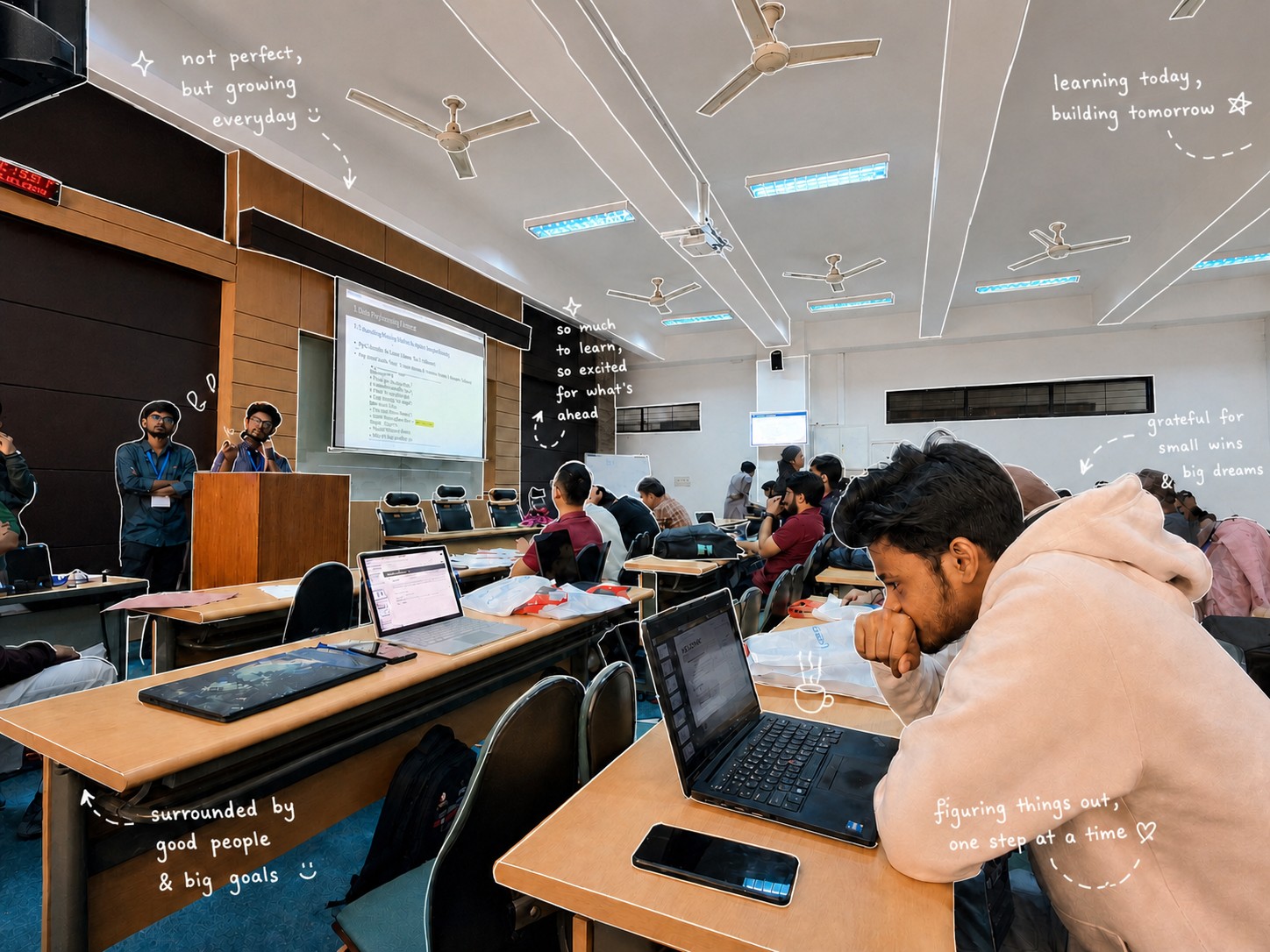
A friend once reminded me that my story is what sets me apart. For a long time, I hesitated to embrace it — but they were right. So, here is a short, honest account of how I got here.
I grew up in Dhaka, Bangladesh.
My interest in computers started early, but it took university to turn that curiosity into disciplined engineering.
I joined BNIST in February 2023 to study Computer Science & Engineering. The first semester was a recalibration. Linear algebra, probability, and data structures were suddenly more than subjects — they were the vocabulary of a discipline I wanted to master.
I started building things. Small scripts, then models, then full pipelines.
My first serious project was a hybrid recommendation system for a local business — a mix of collaborative filtering and content-based embeddings. It wasn't glamorous, but it worked. It produced a 10% increase in sales over three months. That result told me everything I needed to know: production systems are where real learning happens.
I joined Kaggle not long after to test my models against the best in the world. What started as casual practice became something I took seriously across 30 competitions. I crafted story-driven notebooks that turned raw data exploration and machine learning into intuitive experiences. A Top 1% finish — 29th out of 4,082 teams — in Road Accident Risk prediction earned me the Kaggle Master rank.
In mid-2025, I noticed that most AI directories charged creators just to get listed. I decided to build one where they didn't, and shipped the entire product solo.
That became Toolly — an AI tools discovery platform featuring 400+ curated tools across 15 categories, an automated submission pipeline, and a Learn AI hub. I built it solo across 200+ commits, maintained it for 11 months, and then open-sourced it entirely for the community.
While building products, I was also researching.
I led a project that became a first-author conference paper: Bangla Diarizz — a domain-adapted speaker diarization system for Bengali long-form audio, presented at BUET CSE Fest 2026. Using knowledge distillation, we achieved a Diarization Error Rate of 0.19, ran at 3.4× real-time on CPU, and delivered a 56% inference speedup — making speech AI accessible to 230 million native speakers who had almost nothing built for them.
That project taught me that low-resource problems are the most creative ones. Building systems where almost no labeled data exists forces a different kind of engineering discipline.
In early 2026, I joined the founding team of a UK-based fintech startup. I started as an AI intern, became an AI Engineer, and was appointed Chief Technology Officer (CTO). We built production Finance AI agents that handle real money and real consequences. In finance, hallucinations are fatal; every agent graph, deterministic pipeline, and microservice has to be strictly reliable, observable, and compliant.
That experience crystallized what was coming next: the future of work isn't humans clicking tools, but autonomous agents executing entire business operations.
In July 2026, I founded ReWoo — an AI-workforce startup that deploys autonomous agents to run entire business functions for companies. We focused ruthlessly on execution. First paying client in 10 days. That client was in the UK.
Around the same time, I joined ELITE Research Lab LLC (Queens, New York · Remote) as a Student Researcher. Working in Educational Research, I investigate machine learning models and cognitive architectures for intelligent learning systems — keeping my engineering grounded in empirical research.
Running ReWoo, researching at ELITE, building production finance agents, and staying at the edge of machine learning is a constant juggle.
But I have learned that momentum is its own reward.
My operating philosophy is simple: Build it. Ship it. Make it earn. Every system I touch must be reliable, observable, and defensible under real constraints. Not impressive in a notebook. Useful in the world. I believe that 60–70% of AI/ML work is disciplined software engineering, and I take that part just as seriously as the modeling.
If you are building something ambitious, I would love to connect. Shoot me an email, and let's talk.
When I do deep work, I listen to music to stay focused. You can check out my playlists on my Spotify account.
I spent a lot of time reading. My only real friends were books. Books make for great friends.
Here is the document where I’ll keep track of all the books I’ve read!
Open →